Dosing Without the Sachet: Refillable Flower Food for UK Workrooms
In a workroom that gets through thirty or forty buckets on a normal week, the little flower food sachet is almost invisible. It arrives in a box, gets torn open, and goes in the bin with the stem offcuts. But add it up over a year and it is one of the most persistent single-use plastics in the shop — and one of the easiest to miss in a green audit.
That is not a reason to bin flower food altogether. Used properly, it does a job: it feeds stems, slows bacterial growth and keeps water cleaner for longer. The question is whether the sachet is the right delivery system for a busy UK florist in 2026.
What is actually in the sachet?
Flower food is not a mysterious brew. Most retail formulations contain four broad groups of ingredients: a sugar source, usually glucose or sucrose, to feed the stem; an acidifier such as citric acid to bring the water pH down; a biocide to slow bacteria and biofilm; and sometimes an ethylene inhibitor for ethylene-sensitive flowers. There are buffers, wetting agents and other bits in some products, but that is the core.
The sugar is why flower food works — and why it can go wrong. More sugar means more food for bacteria as well as stems. If the bucket is dirty, the stems are not cut cleanly or the water is warm, the biocide can be overwhelmed. Flower food is not a rescue remedy for a grubby bucket. Clean buckets, fresh cuts and stripped lower foliage still do most of the work.
Water quality matters too. In hard-water areas of the UK, high alkalinity can buffer the acidifier and push the pH back up. A product dosed for soft water may not perform the same way in a Kent or London workroom. That is one reason pre-measured sachets are popular: they take the guesswork out. The trade-off is that you cannot adjust the dose to your water or your flower mix.
The sachet maths
Let us use a 10-litre bucket as the unit. A common 5g sachet is dosed at one per 500ml, so a full 10-litre bucket needs twenty sachets. At a trade price of around 8p per sachet, that is £1.60 per bucket. At a retail-style 12p per sachet, it is £2.40. A shop running 30 buckets a week is opening 600 sachets a week — around 30,000 a year.
| System | Unit cost | Dose for 10L bucket | Cost per bucket | Waste per bucket |
|---|---|---|---|---|
| 5g sachets, trade pack | 8p each | 20 sachets | £1.60 | 20 laminate sachets |
| 1L concentrate at 1:100 | £18 per litre | 100ml | £1.80 | one bottle per 100 buckets |
| 5L concentrate at 1:100 | £55 per 5L | 100ml | £1.10 | one jerry can per 500 buckets |
| 5L concentrate at 1:1000 | £55 per 5L | 10ml | £0.11 | one jerry can per 5,000 buckets |
Two warnings. First, dilution rates vary wildly. A concentrate that looks cheap per litre can be more expensive per bucket than sachets if it is dosed at 1:100. Second, the 1:1000 line is only relevant if the label actually says so; do not assume. Check the dose rate, not the headline price.
At 30 buckets a week, the 5L concentrate at 1:100 costs roughly £33 a week in flower food, against £48 a week for trade sachets. That is a saving of around £750 over a 50-week year, before you count the reduced packaging and the space saved in the cupboard. A 1L concentrate at the same dilution would cost more than sachets, so bulk size matters.
What a refillable system looks like in practice
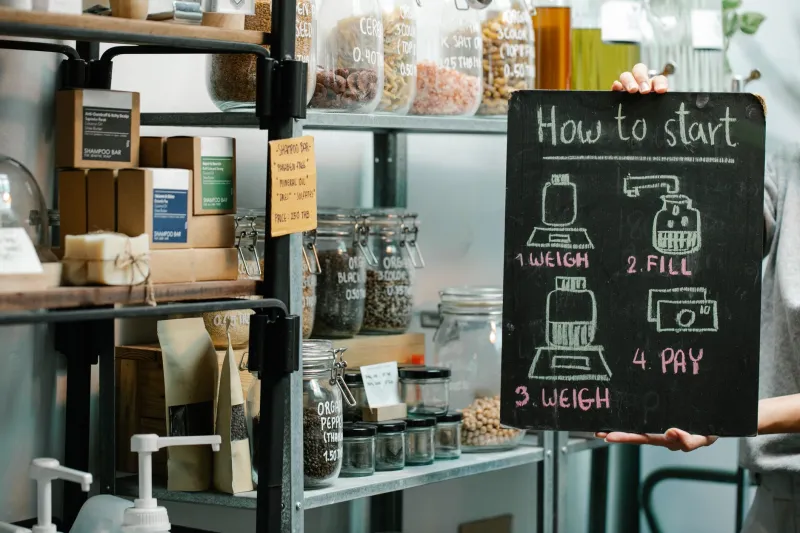
You do not need a laboratory. Most shops can set up a simple dosing station: a 5L or 10L jerry can with a tap, a calibrated dosing pump or measuring jug, a laminated wall chart with the dose for each bucket size, and a logbook for when a new can is opened. Keep the concentrate off the main bench, store it out of sunlight and follow the safety data sheet.
The bigger change is habits. Staff need to know which bucket gets which dose, and they need a way to measure 10ml or 100ml without guessing. A pump that delivers a fixed dose per litre is more reliable than a jug, but it needs calibrating and cleaning. Label made-up buckets with the date and the product. Do not top up old solution with fresh and hope for the best.
Refill options are still patchy in the UK. Some suppliers offer returnable jerry cans or refill stations; others sell only virgin plastic. Ask before you buy. A 5L can that is reused ten times is a different proposition from a 5L can that goes to landfill every month.
A short supplier checklist
Before you switch, ask:
- What is the exact dilution rate, and is it tested for hard water?
- Which biocide does it use, and at what concentration?
- Is the concentrate available in returnable or refillable containers?
- What is the shelf life once opened, and how should it be stored?
- Can you supply a calibrated dosing pump and a bucket-size chart?
- What is the cost per litre of made-up solution at our water hardness?
- Is there a small trial size so we can run a side-by-side test?
- Does it work with the flower types we buy most — and with any STS products we use?
- What is the packaging made of, and can it be recycled kerbside?
- Do you offer staff training or a simple SOP?
Run a trial before you commit: same stems, same bucket size, same water temperature, same cleaning routine. Compare vase life at day three, day five and day seven. If the concentrate does not match the sachet, the saving is irrelevant.
The bottom line
The sachet is not the enemy. It is a convenient default that no one has had a reason to question. But for a shop running dozens of buckets a week, refillable concentrate can cut packaging dramatically and, at bulk dilution rates, cut cost per bucket too. Do the maths on your own water, your own bucket size and your own dose rate. Then ask your supplier the awkward questions.